





Icon Saint Basil polisher
Price range: €40,00 through €100,00 "without VAT"
Icon of Saint Basil polished with handmade silk screen printing on a polished gold background in various dimensions. All images of the Orthodox calendar are made in any size.
Icon of Saint Basil polished with handmade silk screen printing on a polished gold background in various dimensions.
All images of the Orthodox calendar are made in any size.
Feast of 1 January
This great father and teacher of the Orthodox Church was born in 329 A.D., according to others in 330 A.D., in Neocaesarea of Pontus in the village of Annisa and grew up in Caesarea of Cappadocia. The encyclopaedic dictionaries mention Caesarea in Cappadocia as the homeland of Basil the Great. He had 8 brothers, 3 boys and 5 girls. Of the 4 boys, 3 became bishops (Basil of Caesarea, Gregory of Nyssa and Peter of Sebaste) and one became a monk (Naucrates).
Of his five sisters, the first, and at the same time the eldest child of the family, Makrina, became a nun. His parents Vasilios (also himself), who came from Neocaesarea of Pontus, and Emmelia, who came from Cappadocia, although noble and rich in the world, were at the same time of the most unabashedly Christian mindset. They even laid the first – crucial – spiritual foundations of the Saint.
With this Christian upbringing, Basil begins an amazing upward spiritual journey. Having the gifts of wit and memory, he conquers almost all the sciences of his time. Most importantly, he conquers the divine theory of the Gospel, which he immediately puts into practice by his strict ascetic life.
But let us briefly mention the course of its activities. After his first studies in Caesarea and then in Byzantium, he visited Athens, still a young man, where he completed his studies for four years, studying philosophy, rhetoric, grammar, astronomy and medicine, having as his fellow students Gregory of Nazianzus (the theologian) and Julian the Parabaptist.
From Athens he returned to Caesarea and taught the art of rhetoric. He decided, however, to follow the monastic life and therefore went to the centres of asceticism, to learn the monastic state in Egypt, Palestine, Syria and Mesopotamia. When he returned, he retired to a monastery in Pontus, after becoming a monk, and practiced there with all rigour for five years (357 – 362 AD).
Already perfectly trained in the Orthodox Faith, he was ordained deacon and elder by Bishop Eusebius of Caesarea. His exemplary manner of spiritual work did not take long to elevate him to the throne of the high priesthood, succeeding Eusebius in the bishopric of Caesarea (370 AD). With steadfastness and brave spirit, as high priest he made many struggles for the Orthodox Faith. With the Orthodox speeches he wrote, he struck down the sentiments of the evil-doers.
In his struggles against Arianism he proved to be adamantine, neither the flattery of the royal court of Waleda (364 – 378 AD), who went in person to Caesarea to convert him to Arianism, nor the threats of Modestus could break the orthodox conviction of the Saint. He courageously defended Orthodoxy, astonishing the king and the Arians. He also fought against moral rot and brought about wise reforms in monasticism.
The rest of his pastoral activity was unparalleled, building the famous “Vassiliada”, a complex with charitable institutions, such as an orphanage, an orphanage, a nursing home, a hotel and a hospital, etc., where thousands of sufferers of all ages, races and races found food and care.
Basil the Great has a rich and important literary work. His main works are the 9 discourses in the Hexameron, discourses on the Psalms, many and various other discourses, ascetical works and letters. Apart from his other works, he also wrote a Divine Liturgy, which, after the prevalence of the shorter one of St. John Chrysostom, is celebrated 10 times a year: on 1 January (where his memory is also celebrated), the first five Sundays of Lent, on the eve of Christmas and Epiphany, on Maundy Thursday and on Holy Saturday.
At the age of fifty, Basil the Great, because of his weak constitution and his strict ascetic life (some sources say because of a severe liver or kidney disease), on January 1, 378 A.D. or according to others in 379 to 380 A.D., he leaves this perishable and futile world, leaving a legacy and a sacred heritage to humanity of an enormous spiritual work.
The custom of the Christmas cake
In the years of Julian the Betrayer, when Byzantium declared war on Persia, Julian passed through Caesarea with his army. He then ordered the whole province to be taxed and the money was to be taken on his way back to Constantinople. Thus, the inhabitants were forced to give what they each had in gold coins, etc. But Julian was killed ingloriously in a battle in the war with the Persians, so he never passed through Caesarea again.
Then Santa Claus gave an order and from the collected gold jewellery half of it was given to the poor, a small part was kept for the needs of the institutions of Vassiliada, and the rest was distributed to the inhabitants in an original way: He gave orders to knead breads, and in each bread, he put a coin or gold coin inside, then he distributed them to the houses, so that while eating the breads the inhabitants always found something inside. Thus, the custom of the pie was born, which was called βασιλόπιτα.
- 100% guaranteed transaction!
- 100% money back guarantee!
- Immediate delivery to the products we have in stock.
| Weight | N/A |
|---|---|
| Dimensions | N/A |
| Icon Decoration | with handmade serigraphy, with polished gold, with wood |
| Size | Big – LG, Medium – MD, Small – SM, Very large – XL |
| Style - Technique | glossy |
| Collection | Athonite Items, Church supplies |
| Icon Type | Polisher, Serigraphy |
| Material | Wooden |
| Usage | Baptisme use, For the faithful people, For the House, For the inauguration, For the Wedding, Για το Ναό |
| Name of Saint | Saint Basil the Great |
Only logged in customers who have purchased this product may leave a review.
You may also like…
Church carpets

Church supplies

Carring Cases
Related products
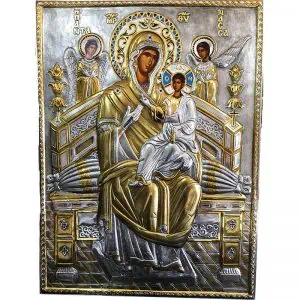
Church supplies
Church supplies
Church supplies

Church supplies
Church supplies
Bread Stamps
Bread Stamps
Church supplies
Reviews
There are no reviews yet.